

Thule Hitch Rack Bike Guide: Which Model Actually Deserves Your Money in 2026?
A Thule hitch rack bike setup is probably the single most talked-about answer to that problem, and honestly? Most of the hype is deserved. But “most” isn’t “all,” and there’s a real difference between the Thule hitch rack bike that fits your life and the one that just fits your wallet at checkout.
Why a Thule Hitch Rack Bike Setup Beats Roof and Trunk Options
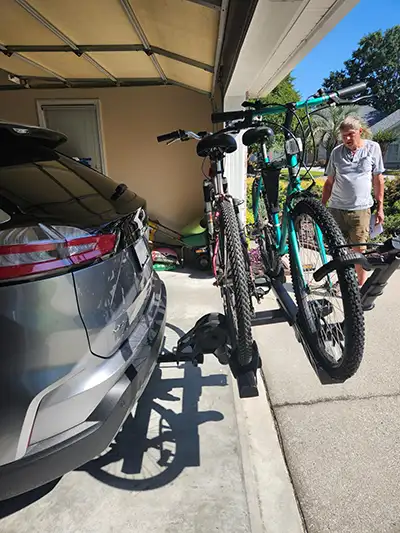
Thule hitch rack bike – Let’s get the obvious question out of the way first: why hitch-mounted at all? Roof racks work, sure, but have you ever forgotten a bike was up there and driven into a parking garage? It happens more than people admit. Trunk racks are cheap and light, but they wobble, they can scuff your paint, and they’re a nightmare with more than two bikes.
A Thule hitch rack bike carrier solves most of that. It sits low, it’s easy to load (no hoisting a 45-pound e-bike over your head), and it keeps your gas mileage from tanking the way a roof-mounted setup does. Think of it like the difference between carrying groceries in a backpack versus balancing them on your head — one is just more sensible.
1. The Core Advantage: Stability Where It Matters
Hitch mounts attach directly to your vehicle’s receiver, which means the connection point is rock-solid metal-to-metal, not straps and suction cups. That stability is exactly why hitch bike racks fall into two basic categories — platform models that are pricier but offer excellent stability and convenience, and hanging racks that maximize carrying capacity in a compact package.



Thule T2 Pro XTR: The Rack That Keeps Winning
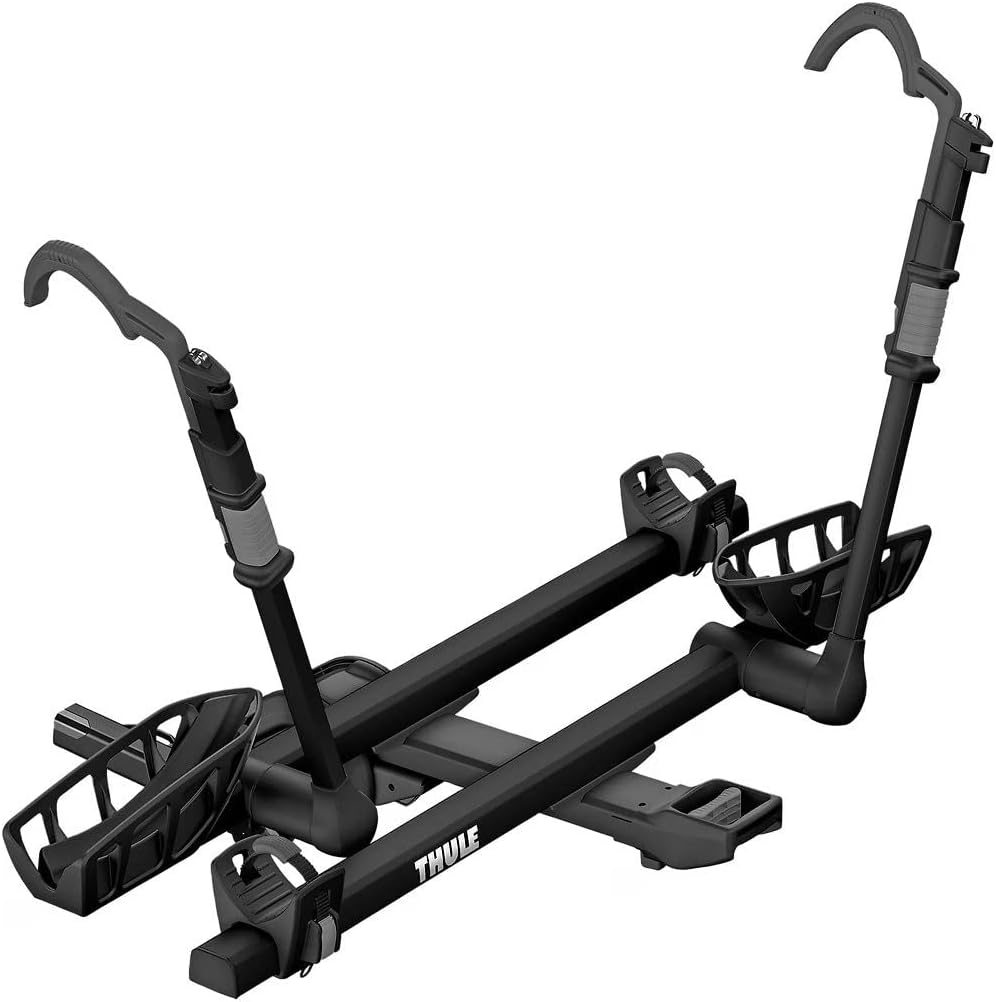
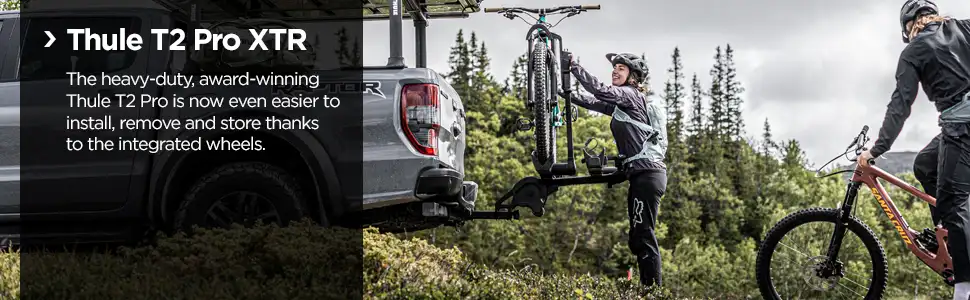
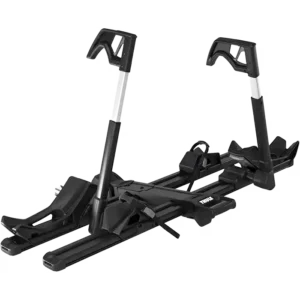
If you ask around, you’ll hear the T2 Pro XTR mentioned constantly, and for good reason. It’s been a top pick for six years running thanks to its build quality, secure bike-carrying design, and complete feature set. It’s essentially the benchmark every other Thule hitch rack bike model gets measured against.


1. What Makes the T2 Pro XTR Special
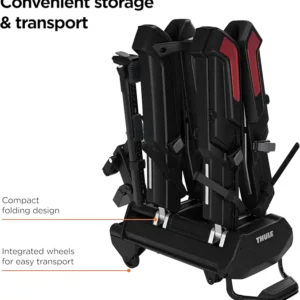
The T2 Pro’s carrying system handles everything from standard road and mountain bikes to fat bikes and even 20-inch kids’ models without needing adapters. That’s a wide net for one rack. On top of that, a user-friendly tilt handle gives quick access to the back of your vehicle, and built-in wheels at the base make it easier to move around when you’re not driving.
Weight-wise, this thing is serious hardware. It’s a platform-style rack weighing around 52 pounds, carries two bikes (expandable to four with add-ons), and supports up to 60 pounds per bike, plenty for most e-bikes.
Thule Verse: The New Flagship Taking Over
Thule didn’t stop innovating after the T2 line took off. Enter the Verse, which is quickly becoming the brand’s go-to answer for riders who want zero compromises.
1. Ergonomics First, Everything Else Second
The Thule Verse is described as a premium, flagship platform rack that sets a new standard for ergonomics and ease of use, handling everything from fat bikes to e-MTBs with zero frame contact and a best-in-class locking system. Priced around $1,000, it builds on the legacy of the T2 Pro XTR with meaningful upgrades in ergonomics and compatibility.
2. Wheel Hooks That Actually Make Sense
One detail reviewers keep pointing out: the new wheel hooks on the Verse have a design that makes loading noticeably easier. It sounds minor until you’re trying to strap in a bike with numb fingers in November. Little touches like that separate a good Thule hitch rack bike purchase from a great one.
Thule Vero: Built for Weird-Shaped Bikes
Not every bike fits neatly into a tray. Fat bikes, cargo bikes, kids’ bikes with training wheels still attached — this is where the Vero comes in.
1. A Hybrid Design That Actually Works
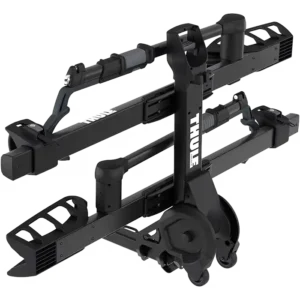
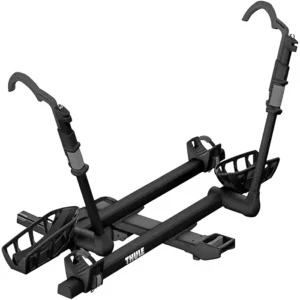
The Vero blends the tray-based stability of the Verse with the flexible telescoping attachment system of the Epos, making it capable of carrying just about anything with two wheels — especially heavy or awkward setups that traditional tray racks struggle with.
It uses telescoping support arms with articulating heads and a ratcheting strap that attaches to either the frame or the rear wheel. It’s not the fastest rack to load, sure, but if your garage looks like a bike museum with mismatched wheel sizes, it’s worth the extra thirty seconds.
Thule Epos: For the Space-Conscious Owner
Got a small garage? An apartment with barely enough room for your car, let alone rack storage? The Epos was basically designed with you in mind.
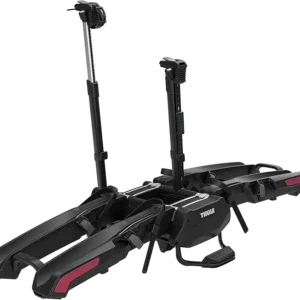
The Thule Epos is built to occupy as little storage space as possible while still accommodating just about any bike you own. It’s a genuinely clever piece of engineering — a Thule hitch rack bike solution that folds down small enough to actually store indoors without becoming a tripping hazard.
Thule Revert: Vertical Storage for Bigger Groups
Need to haul more than two or three bikes without turning your driveway into an obstacle course? The Revert takes a different approach entirely.
The Revert vertical hitch rack, released last year, comes in both 4-bike and 6-bike versions, supports a 55-pound weight limit per bike, and includes damper-assisted tilt in both directions. Vertical racks like this stand bikes upright instead of laying them flat, which massively cuts down the footprint behind your bumper.
Thule EasyFold XT: The Flexible Fit
Here’s a practical wrinkle a lot of buyers don’t think about until they’re already at the store: hitch receiver size. Most full-size SUVs and trucks use a 2-inch receiver, while many smaller SUVs and cars use a 1.25-inch receiver. The EasyFold XT is the diplomat of the lineup here; it fits both receiver sizes through an included adapter, which the T2 Pro XTR also offers in separate versions.
Comparing the Thule Hitch Rack Bike Lineup at a Glance
Numbers are easier to trust than adjectives, so here’s how the main models stack up side by side.
| Model | Style | Bikes Carried | Weight Capacity (per bike) | Best For |
|---|---|---|---|---|
| Thule T2 Pro XTR | Platform | 2 (up to 4 with add-on) | ~60 lb | All-around reliability, mixed bike types |
| Thule Verse | Platform | 2–5 | ~60 lb | E-MTBs, no-compromise ergonomics |
| Thule Vero | Platform (telescoping) | 2–3 | High, adjustable arms | Fat bikes, oddly-shaped frames |
| Thule Epos | Platform (foldable) | 2–3 | Frame/wheel mount, carbon-safe | Small storage spaces, carbon frames |
| Thule Revert | Vertical hanging | 4–6 | ~55 lb | Large families, group rides |
| Thule EasyFold XT | Foldable platform | 2 | Moderate | Vehicles switching hitch sizes |
How to Pick the Right Thule Hitch Rack Bike for Your Vehicle
This is where a lot of people trip up. They fall in love with a rack online, order it, and then discover it doesn’t actually fit their car. Don’t be that person.
1. Check Your Hitch Receiver Size First
Thule maintains a vehicle fit guide that lets you enter your make, model, and year to see exactly which racks are confirmed to fit, and the most important factor is your hitch receiver size. If you skip this step, everything else in this guide is basically irrelevant.
2. No Factory Hitch? You’ve Got Options
If your vehicle doesn’t already have a hitch receiver installed, an aftermarket hitch can typically be added by a professional installer, which then opens up the entire Thule hitch rack lineup. It’s an extra cost, sure, but it’s a one-time investment that pays off every road trip after.
E-Bike Owners: Don’t Skip This Section
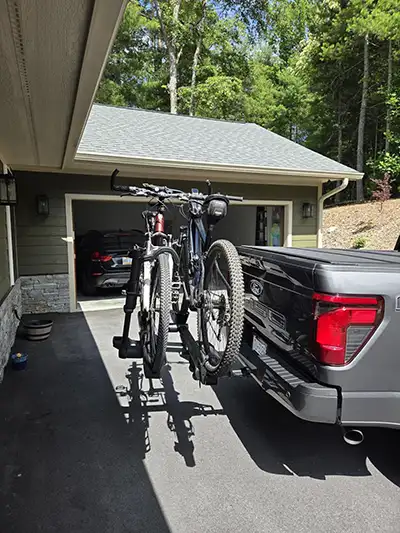
E-bikes are heavy. Like, “please don’t ask me to lift this alone” heavy. A cheap rack rated for 35 pounds is basically asking for trouble.
1. Weight Capacity Really Matters Here
Thule’s premium hitch racks are specifically designed with e-bike weights in mind, which is exactly why the Verse and T2 Pro XTR lean toward that 60-pound-per-bike range. High-end models rated for 60 pounds cover most electric mountain bikes, though they may exclude heavy-duty cruisers or fat-tire e-bikes on the extreme end.
2. Watch Out for the “Add-On Penalty”
Here’s a sneaky detail worth knowing before you buy: many racks reduce their per-bike weight capacity once you add extra trays — for example, one popular model drops from 67 pounds per bike in a two-bike setup down to 40 pounds per bike once expanded to four bikes. Always check the capacity for the exact configuration you plan to run, not just the base model.
3. Loading Ramps Save Your Back
Deadlifting an e-bike onto a rack tray is how backs get thrown out. Good news: a $100 foldable loading ramp accessory is compatible with the newer Verse and Epos lines, and it genuinely changes the loading experience from a struggle into a simple roll-up.
Installation Tips Nobody Tells You Upfront
Installing a Thule hitch rack bike carrier isn’t rocket science, but a few small habits save real headaches.
- Tighten the hitch pin fully and check it again after your first few miles of driving — vibration loosens things faster than you’d expect.
- Load heavier bikes closest to your vehicle for better weight distribution.
- Use a hitch lock, not just a bike lock; racks themselves get stolen too.
- If your rack has a tilt or swing-away feature, test it in your driveway before your trip — not for the first time at a gas station.
Maintenance: Keep Your Rack From Rusting Out
A rack lives outside, exposed to road salt, rain, and grime. Rinse it occasionally, lubricate moving joints (the tilt hinge especially) every season, and check the straps or wheel hooks for cracking. A five-minute check twice a year adds years to the thing’s life.
Budget vs. Premium: Is the Splurge Worth It?
Not everyone needs the flagship. If you’re hauling one commuter bike twice a month, a mid-tier rack does the job fine. But if you’re loading multiple e-bikes for weekend trips, the extra few hundred dollars on a Verse or Vero buys you peace of mind — and honestly, peace of mind is underrated when you’re doing 70 mph on the highway with $6,000 worth of bikes hanging off your bumper.
Common Mistakes People Make Buying a Thule Hitch Rack Bike
A few patterns show up again and again in owner forums and reviews:
- Buying based on price alone and ignoring receiver size compatibility.
- Assuming a 2-bike rack’s weight rating applies once expanded to 4 bikes.
- Skipping the hitch lock and having the rack (not just the bikes) stolen.
- Not test-fitting fenders or unusual frame shapes before a long trip.
- Forgetting to remove or fold the rack for tight parking garages — clearance drops fast with bikes loaded.
Final Thoughts on Choosing Your Thule Hitch Rack Bike
At the end of the day, picking the right Thule hitch rack bike setup comes down to three honest questions: what do you ride, how many bikes do you actually carry at once, and what does your vehicle’s hitch support? Answer those truthfully, not aspirationally, and the right model becomes obvious pretty fast.
Whether that’s the tried-and-true T2 Pro XTR, the ergonomic Verse, the flexible Vero, or the compact Epos, Thule has genuinely built something for nearly every rider. Get the fit right, install it properly, and you’ll spend a lot less time worrying about your bikes and a lot more time actually riding them.
| Bike Rack Collections Near You | |
|---|---|
 |
 |
| Get Amazon Special Offers | Get Walmart Special Offers |
FAQs About Kuat Piston Pro X
Is a Thule hitch rack bike carrier better than a roof rack?
For most drivers, yes. Hitch racks sit lower, load easier, don't hurt your fuel economy nearly as much, and remove the risk of forgetting a bike is up top and clipping a garage ceiling.
What size hitch receiver do I need for a Thule hitch rack bike?
It depends on your vehicle — most full-size SUVs and trucks take a 2-inch receiver, while smaller cars and crossovers often use a 1.25-inch receiver. Check your vehicle's specs or Thule's fit guide before buying.
Can a Thule hitch rack bike carrier handle heavy e-bikes?
Many of the premium models can, with weight capacities around 55–60 pounds per bike. Just double-check the rating for your exact configuration, since adding extra bike trays can lower the per-bike limit.
How many bikes can I fit on a Thule hitch rack?
It ranges by model — compact platform racks typically carry 2 bikes with room to expand to 3 or 4, while vertical hanging racks like the Revert can carry up to 6.
Do I need a hitch lock in addition to a bike lock?
Yes, ideally. A bike lock protects your bikes, but a separate hitch lock protects the rack itself from being unbolted and taken — a surprisingly common theft target.
You Might Also Like
- Kuat Piston Pro X Setup: Installing and Attaching
- Is a Kuat Bike Rack Worth It? The Honest 2026 Buyer’s Guide
- Most Reliable Hoverboard Brand: Your Ultimate Buyer’s Guide
- Gyroor Hoverboard Self Balancing Scooter
- FLYING-ANT Self Balance Scooter 6.5″ with Speaker
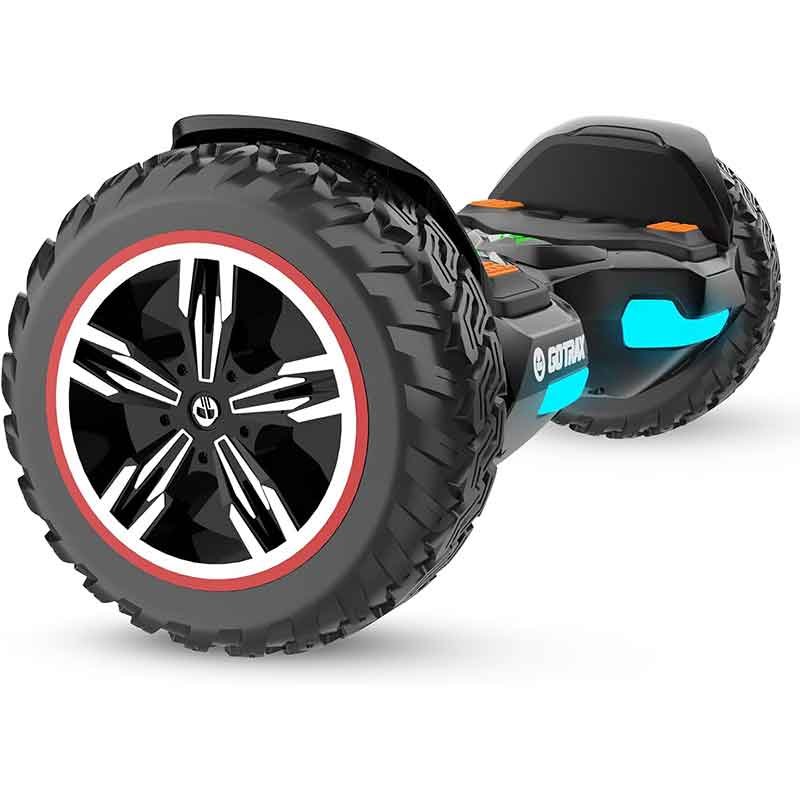
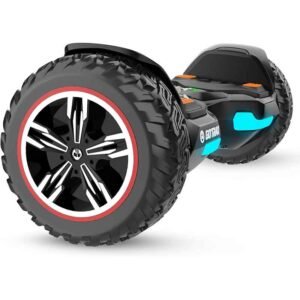
 H1 is powered by two 200W motors that enable it to climb 15 degree inclines and reach a 9 mph top speed. The 6.5″ solid wheels provide a smooth and enjoyable ride.